
2026-09-16
How to Choose the Right Palletizing Robot for Your Factory?
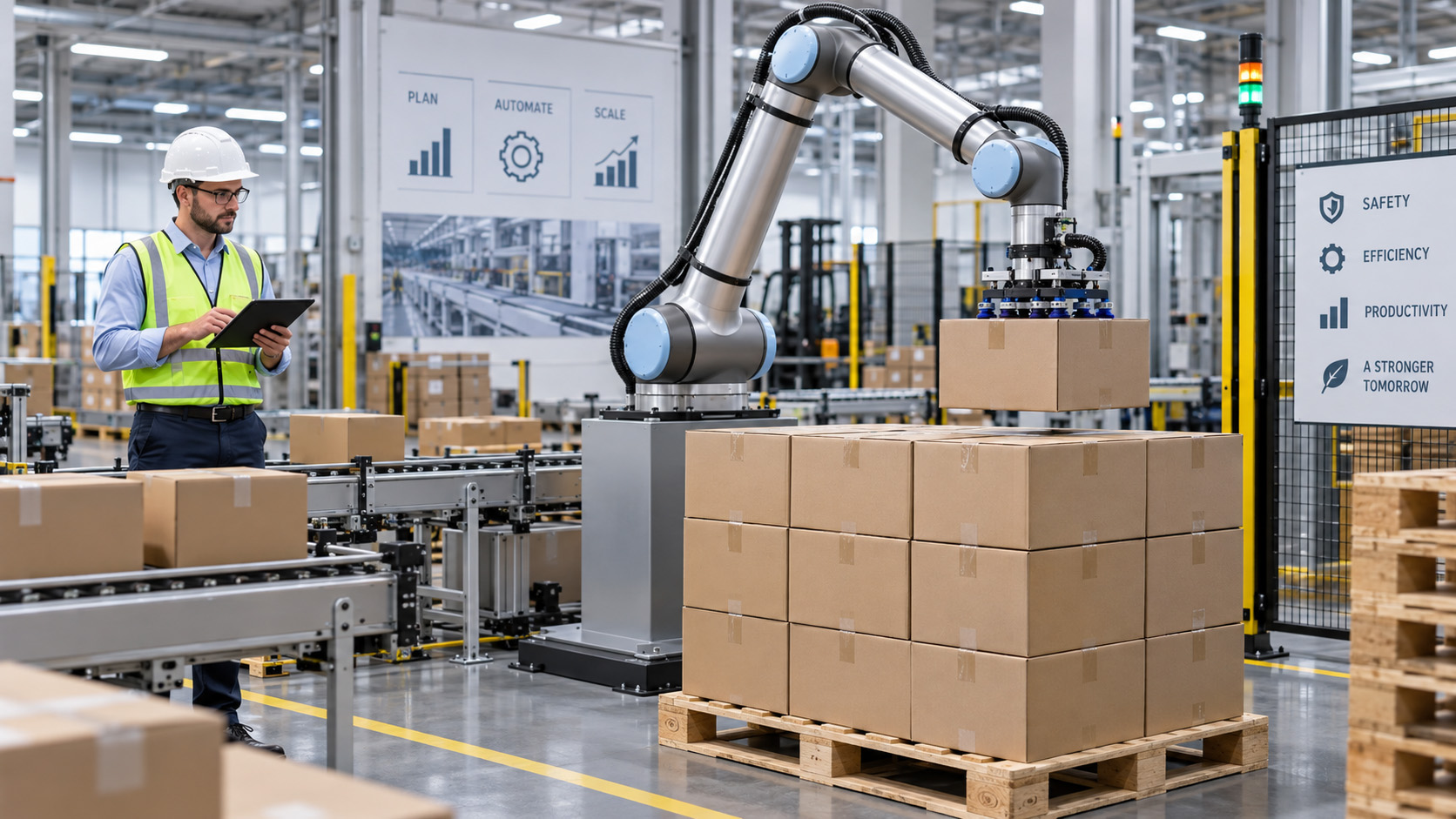
Choose a palletizing robot by validating the complete application: product and gripper load, sustained line throughput, pallet coverage, package handling, safety, integration and lifetime cost. A robot that meets a catalogue specification may still fail to meet your production target once pallet changes and operating conditions are included.
For plant managers, packaging engineers and procurement teams, the most useful starting point is a written application brief. Use it to compare complete robotic palletizing systems on the same basis.
1. Define the product and production requirements
Record every product variant, or SKU: minimum and maximum package dimensions, weight, packaging material, centre of gravity and condition at the conveyor exit. Include partially filled cartons, flexible bags, slippery film and any damaged packaging that can reasonably occur.
Specify average and peak arrival rates, shifts, pallet dimensions, maximum loaded height, layer patterns, slip sheets and permitted overhang. Separate future requirements from current needs so suppliers can show the cost of expansion.
2. Calculate payload with the gripper included
The robot carries more than the product. Include the gripper, mounting hardware and other equipment carried at the wrist. Check the selected model’s load diagram, centre-of-gravity limits and allowable inertia. Universal Robots’ payload guidance explains the relationship between payload and its centre of gravity.
Illustrative calculation: a 12 kg carton plus a 5 kg gripper and 1 kg adapter gives an 18 kg carried load. Picking two cartons raises it to 30 kg. These are application calculations, not model recommendations; the proposed motion still needs validation.
Ask the supplier to document the heaviest configuration and the configuration with the most demanding load offset. A fixed percentage of spare payload cannot replace this check.
3. Verify sustained throughput, not just robot speed
Specify output as acceptable cartons per minute over an agreed operating period. Include picking, travel, placement, slip-sheet insertion, pallet exchange and expected recovery events. Ask whether quoted performance is picks per minute or cartons per minute, especially for multi-pick tooling.
Illustrative sizing: a line delivering 12 cartons/minute needs a nominal 15 cartons/minute if the cell is assumed to produce at that rate for only 80% of the period: 12 ÷ 0.80 = 15. This simplified assumption is not a performance guarantee. A buffer and peak-arrival analysis are still required.
Test the most difficult pallet positions and products. A short demonstration with an easy carton does not establish sustained production capacity.
4. Compare palletizing robot configurations
| Configuration | When to evaluate it | What to verify |
| --- | --- | --- |
| Collaborative palletizing system | Frequent product changes and accessible operation | Actual output with the required safety measures |
| Dedicated industrial palletizer | Repetitive stacking, heavy loads or demanding throughput | Guarding, pallet logistics and integration scope |
| Six-axis industrial robot | Products requiring additional orientation | Motion path, cycle time and programming complexity |
These are overlapping application categories, not universal speed or payload rankings. Compare the proposed cells using the same products, layouts and acceptance criteria.
5. Check reach, layout and gripper performance together
Verify all pallet corners at the bottom and top layers, including the approach and withdrawal paths. Model the gripper geometry, conveyor height, pallet location and any lifting column. Nominal arm reach alone does not prove usable coverage.
Measure the entire operating area: pallets, conveyors, protective devices, forklift routes, service access and electrical cabinets. A compact robot base can still require a substantial working area.
Test gripping with production samples. For vacuum tooling, assess surface leakage, tape seams and release behaviour; for mechanical tooling, check crushing, clearance and product support. Define how the system detects a missed pick or dropped product and recovers without creating an unstable pallet.
6. Review safety and integration before ordering
Safety must be assessed for the complete application, including the gripper, carried product and pallet handling. A cobot label alone does not establish that a cell can operate without guarding. ISO 10218-2:2025 addresses industrial robot applications and cells; confirm the applicable local requirements with the integrator.
Agree conveyor handshakes, PLC interfaces, upstream stops, pallet-ready signals and downstream wrapper coordination. Demonstrate SKU recipe changes, access permissions, backups and restart after a power interruption. Confirm environmental limits, utilities and local service arrangements.
7. Compare total cost and agree acceptance tests
Request an itemised installed price covering the robot, tooling, conveyors, safety equipment, installation, programming and training. Add maintenance, consumables, energy, software fees and expected downtime to the operating comparison.
Simple payback = installed investment ÷ annual net operating benefit. Use documented avoidable costs and subtract new operating expenses. Redeployed labour is not automatically a cash saving, and extra output has value only if it can be sold or used. Compare conservative and expected scenarios; avoid counting the same benefit twice.
Before purchase, agree factory and site acceptance tests (FAT/SAT): representative SKUs, run duration, acceptable sustained output, pallet stability, package damage, changeover time, recovery and safety validation. Allocate responsibility for each test and record the conditions behind every performance commitment.
Supplier enquiry checklist
- Product dimensions, weight range, packaging samples and SKU list.
- Average and peak arrival rates, shifts and growth requirements.
- Pallet sizes, stacking heights, patterns and slip sheets.
- Dimensioned layout, utilities and environmental conditions.
- Control interfaces, pallet exchange and downstream equipment.
- Acceptance criteria, service expectations and installed budget.
Use this brief when discussing your application with UBT Robotics. Explore the collaborative robot range and request a configuration supported by layout review and product testing.
Frequently asked questions
What payload does my palletizing robot need?
Start with the combined product and tooling load. Then validate the chosen robot’s load limits for the actual geometry and motion, including multi-pick operation.
Is a cobot always the best choice for a small factory?
No. Evaluate the complete cell’s space, required output, access and safeguarding. Factory size alone does not determine the right robot type.
Can one robot palletize different products?
Potentially, if the tooling, recipes and product flow support them. Changing between single-SKU batches is different from building mixed-SKU pallets, which requires additional sequencing and stability checks.
How much does a palletizing robot system cost?
A meaningful price requires a defined application and integration scope. Compare installed systems with equivalent tooling, safety, pallet handling and support, rather than robot-arm prices alone.