
2026-09-19 · pinned
Technology Evolution | SLAM + 3D Vision Fusion Becomes Standard Configuration for Next-Generation AMR Robots
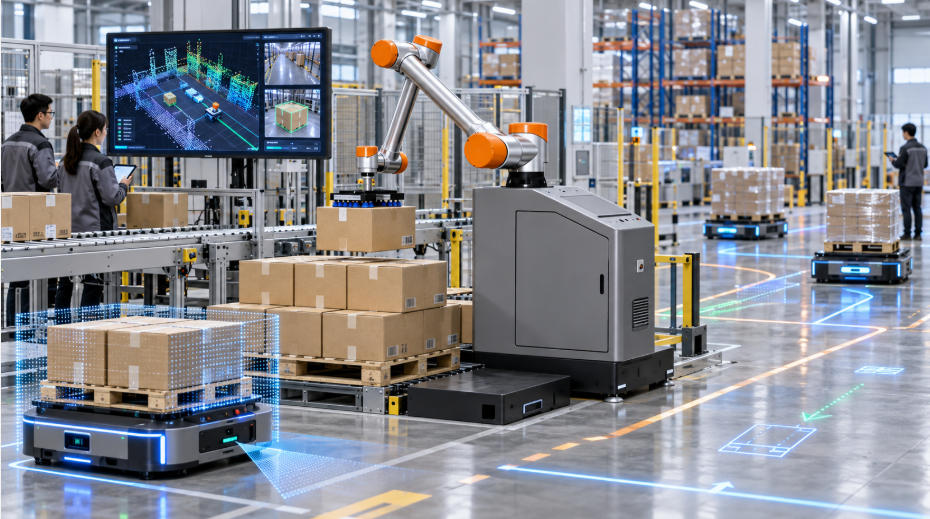
As industrial scenarios demand ever greater flexibility and autonomy from mobile robots, the limitations of single navigation technologies are becoming increasingly apparent. Recently, top global mobile robot makers have released next-generation products, and SLAM (Simultaneous Localization and Mapping) + 3D vision fusion perception is becoming the standard configuration for mid-to-high-end AMRs (Autonomous Mobile Robots), marking a new stage of smarter autonomous operation for industrial mobile robots.
Technology Evolution: From Single Navigation to Multi-Perception Fusion
Traditional AGVs mostly use magnetic strip or QR code navigation — mature but inflexible, requiring floor modification, fixed routes and poor adaptability to dynamic production scenarios. Single laser SLAM navigation achieves trackless autonomous movement but has shortfalls in recognizing transparent objects, dark objects and complex terrain, with limited environmental perception.
The new SLAM + 3D vision fusion solution achieves dual upgrades in positioning and perception:
Positioning: Laser SLAM enables large-scale high-precision mapping and positioning; combined with visual feature matching, positioning is more stable in dynamic environments, working normally even with significant scene changes.
Perception: 3D vision cameras collect real-time environmental depth information, accurately identifying obstacle type, size and position, and detecting transparent glass and low obstacles that LiDAR easily misses — greatly improving dynamic obstacle avoidance.
Operation: 3D vision guides the robot to complete precise docking, material picking and pallet recognition, crossing from "getting there" to "doing it well" — truly replacing manual work in the full process.
Application Value: Greatly Improved Adaptability to Complex Scenarios
No scenario modification: No magnetic strips or QR codes, no floor or line modification. Fast deployment and flexible route adjustment, especially suitable for old factory upgrades and high-mix, low-volume production.
Dynamic environment operation: Adapts to dynamic workshop environments with people moving and materials temporarily placed. Smarter, smoother obstacle avoidance enables true human-machine mixed operation without dedicated lanes.
Improved operation precision: Under 3D vision guidance, docking precision with lines, workstations and pallets reaches millimeter level, supporting loading/unloading, handling and palletizing needs.
Industry Dynamics: From High-End Flagship to Mid-Range Popularization
Previously, SLAM + 3D vision fusion was mostly used in high-end flagship models at higher prices. As the supply chain matures and algorithms optimize, the technology is rapidly sinking to mid-range products, with more mainstream makers' mid-range AMRs adopting fusion perception, greatly improving equipment cost-performance.
On the application side, automotive manufacturing, electronics assembly and warehouse logistics are among the first to scale adoption. The 3C electronics industry especially — with fast line iteration and complex scenarios — has high demands for AMR flexibility and precision, where fusion navigation advantages are clear.
Industry insiders say that within 2–3 years, SLAM + 3D vision fusion will become standard for mid-to-high-end AMRs, and will gradually reach entry-level products. Mobile robots will upgrade from "handling tools" to "intelligent operation nodes," playing a more core role in industrial automation systems.