
2026-09-20 · pinned
Regional Dynamics | Southeast Asia's Manufacturing Automation Accelerates: Demand for Small and Medium Payload AGVs and Palletizing Robots Doubles
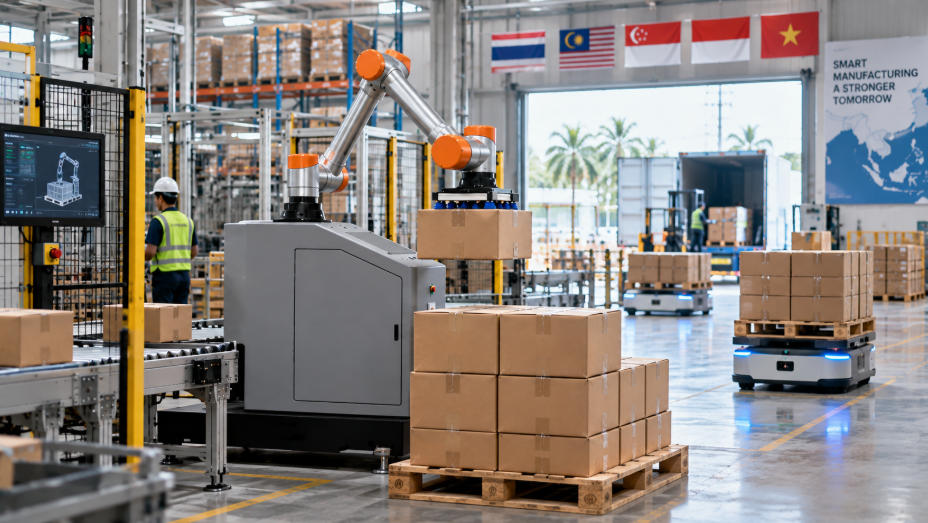
In recent years, global manufacturing capacity continues to shift to Southeast Asia, with Vietnam, Thailand, Indonesia and other countries rapidly expanding manufacturing scale. At the same time, widening labor gaps and rising labor costs are increasingly prominent, driving rapid growth in industrial robot demand. Among these, small-to-mid payload AGV handling robots and collaborative palletizing robots — with high cost-performance and easy deployment — have become the first choice for local factory automation upgrades, with demand showing explosive growth.
Industry Background: Dual Drivers of Capacity Expansion and Labor Gap
Southeast Asia's manufacturing growth is evident, with electronics, textiles, food and daily necessities capacity continuously moving in, and factory numbers and scale expanding. But labor problems are also increasingly prominent:
Insufficient labor supply: Young people have diverse employment choices, factory worker gaps keep widening, especially for heavy roles like handling and palletizing — hiring difficulty and high turnover are common.
Rising labor costs: Southeast Asian countries' minimum wage standards rise yearly, plus training and vacancy costs from turnover; company labor pressure keeps increasing, and the economic feasibility of automation replacement keeps improving.
Upgraded order requirements: As global customers raise demands for capacity, quality and delivery stability, local factories urgently need automation to improve production efficiency and management, strengthening order competitiveness.
Demand Characteristics: Small-to-Mid Payload, High Cost-Performance Equipment as Mainstream
Preference for small-to-mid payload: 30–60kg palletizing robots and 100–500kg payload AGVs are most popular, matching most local factories' production scale and material weight, with lower entry barriers.
Value cost-performance and ease of use: Local companies generally have limited budgets, preferring high cost-performance equipment, with low operation complexity requirements — no-code, easy-to-use products are favored.
High deployment speed requirements: Factory orders fluctuate greatly; they want fast deployment and quick results. Lightweight solutions without large factory modification fit better.
Chinese brands, with complete supply chains, high cost-performance products and fast delivery service, continue to gain share in Southeast Asia — especially in small-to-mid payload AGVs and collaborative palletizing robots, where Chinese makers have clear competitive advantages.
Hot Scenarios and Future Outlook
In terms of application scenarios, electronics assembly, food processing and daily necessities manufacturing are currently the three industries with the strongest automation demand, with line material handling and finished goods palletizing as the main application links. Meanwhile, e-commerce and logistics warehousing development is also driving demand for warehouse handling robots.
Industry institutions predict that in the next 3 years, the Southeast Asia industrial robot market will maintain over 25% CAGR, with handling and palletizing robots growing faster than the overall level. As local manufacturing upgrades to higher value-added, automation demand in more processes will gradually release — huge market potential.
For companies going global, deeply adapting to Southeast Asian market product characteristics and localized service will be key to capturing market share.