
2026-09-19 · pinned
Market Trends | 2026 Global Collaborative Palletizing Robot Market Report: Small and Medium-sized Factories Become the Core Growth Driver
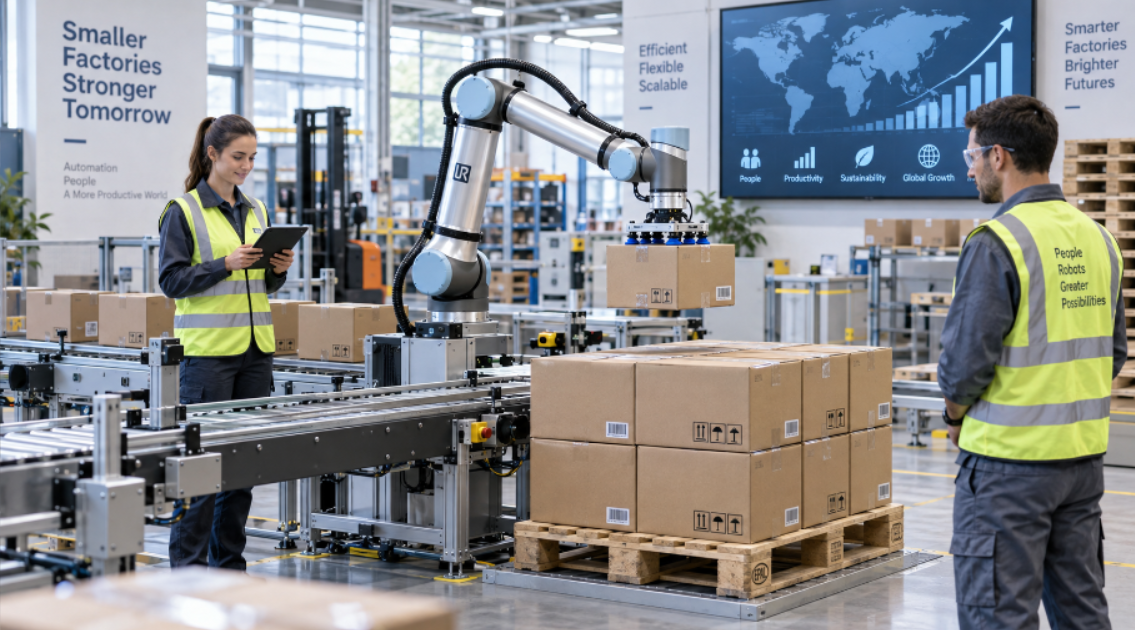
According to the 2026 industrial robot market report recently released by the International Federation of Robotics (IFR) and industry research institutions, the global collaborative palletizing robot market continues to grow rapidly at a 22% CAGR, significantly higher than the overall traditional industrial robot growth rate. Among this, surging automation demand from small and mid-sized manufacturers has become the core growth driver.
Market Growth: SMEs as Main Force, Lightweight Equipment Favored
Report data shows that 2025 global collaborative palletizing robot shipments grew 24% year-on-year, with 30–60kg payload models accounting for over 65% — the most mainstream product segment. Unlike previous automation upgrades led by large enterprises, this round's core driver comes from small and mid-sized manufacturers with 50–500 employees, whose deployment share exceeds 60%.
Three core factors are releasing SME automation demand: first, lower technical barriers — no-code, visual collaborative robots break the technical wall, letting ordinary workers operate without a programming team; second, improved ROI — lightweight collaborative palletizing equipment prices are falling, with payback commonly shortened to under one year; third, labor pressure transmission — global manufacturing labor costs keep rising and frontline worker gaps widen, especially for heavy, repetitive roles like palletizing and handling, forcing companies to accelerate automation replacement.
Regional Landscape: China Leads Growth, Southeast Asia Demand Accelerates
Regionally, China continues to hold the world's fastest growth rate, with 2025 collaborative palletizing robot shipments up 28% year-on-year, driven by a mature local supply chain and clear cost-performance advantages. In the Pearl River Delta and Yangtze River Delta manufacturing clusters, SME automation penetration is rising rapidly, shifting from pilot applications to scaled adoption.
Southeast Asia is becoming a new growth pole. In Vietnam, Thailand, Indonesia and other manufacturing承接 countries, as capacity expands and labor gaps widen, demand for small and mid-payload AGVs and palletizing robots surges, with annual growth exceeding 25%. Chinese brands, with high cost-performance, fast delivery and localized service, continue to gain share in Southeast Asia.
Europe and North America maintain stable growth, with companies more focused on equipment safety compliance and system integration capability. Collaborative robots continue to deepen applications in food, personal care and pharmaceutical industries. Meanwhile, updated human-machine collaboration safety standards are also driving equipment iteration.
Future Trends: Technology Fusion and Scenario Sinking
The report notes that in the next 3–5 years, the collaborative palletizing robot market will continue high growth, with two major technology trends: first, perception fusion — SLAM navigation, 3D vision and collaborative robots combined to further improve scenario adaptability and autonomous operation; second, digital integration — equipment deeply connects to MES, WMS and other production management systems, upgrading from standalone automation to workshop digital nodes.
At the same time, application scenarios will continue to sink. More sub-sectors and smaller factories will join the automation upgrade ranks, and lightweight, easy-to-deploy, cost-effective equipment will remain the market mainstream.